Tax returns available
A 2026 tax return with a Not started status will be created if a 2025 return was created by 31 March.
A 2026 tax return won't be created if a 2025 return wasn't created, or if a 2025 return was created but has a Not started status.
To roll over data from the 2025 return to the 2026 return, click anywhere in the row showing Not started.
You can also add a 2026 return by clicking Add new. This will roll over data if a return existed in the previous year.
In 2026, less data will be rolled over because some schedules containing this data have been replaced with the ability to enter data directly into the tax return.
You'll need to add any missing detail manually in 2026. In following years, data will continue rolling over.
See Enter supporting data directly in the tax return below for more information.
Enter supporting data directly in the tax return
You no longer need to use schedules to add some types of supporting data in a return. Instead, you can expand sections of a return to enter and review supporting data directly in the main form of the return.

Click the icon on the bottom-right of the section of fields to expand more fields for viewing or entering details. If the fields are empty, the icon will be list. If the fields already have details, the icon is a down arrow.

Pre-populated data and data distributed from another return will be updated into these fields if relevant.
Attachments, complex schedules and schedules that don’t link directly to a keypoint are still available as schedules in a separate tab.
The data that was previously in a schedule but is now in the main form won't roll from 2025 to 2026. You'll need to add any missing detail manually this year.
Tax return PDF improvements
We’ve redesigned the tax return preview PDFs for clarity and professionalism. You’ll notice improved readability, enhanced layout and a revamped presentation.
Because entering data directly into a tax return replaces most schedules, the tax return has become more of a key document. So from 2026, Tax statement, Tax return and Schedules are default options when previewing or downloading PDFs.
To reduce the size of the document, there's a new Completed fields only option on by default.
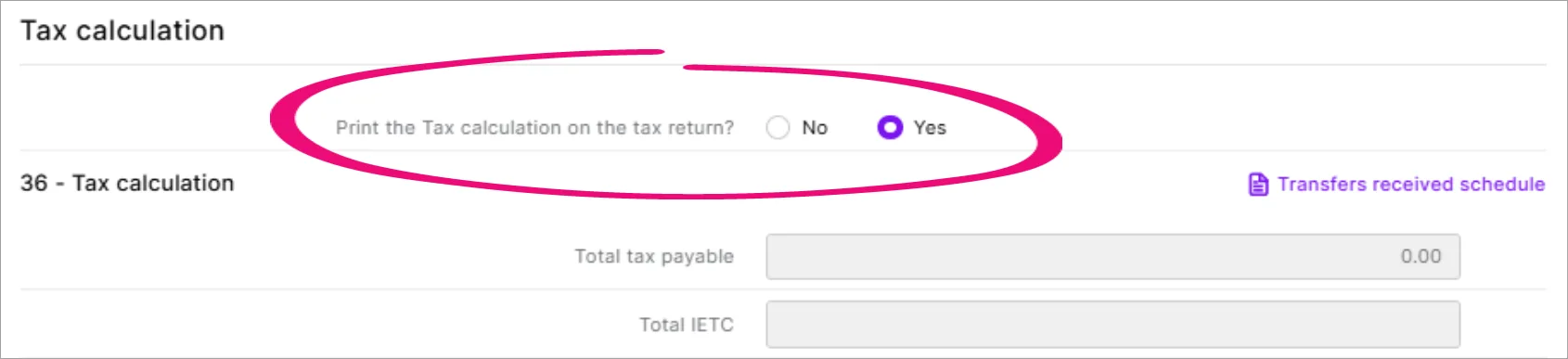
The default combination is also what's included in the PDF when you select Send through client portal.We've given you a Yes/No toggle to control whether the PDF preview shows the Tax calculation, Refunds and Provisional Tax sections. If set to No, these sections won't be shown regardless of the options you choose when you click Preview (PDF) on a return. The default is No, so make sure to choose Yes if you want these sections to appear in the PDF.
As the tax return already contains associations, we've removed the association detail that was printing after the IR4 tax statement for shareholders, after the IR6 tax statement for beneficiaries and settlors, and after the IR7 tax statement for partners or owners. This now only prints with the tax return, including the summary if selected.
Updates to schedules:
As schedules are now a separate option, the IR4J and IR10 attachments will always be included as part of this option, if they exist.
The variance information in the IR10 won't print on the PDF even if there is a variance.
The depreciation section won't print on the business or rental statement if there are no depreciable assets.
The IR526 Tax statement will now more clearly show the total amount being allocated to a partner and to the tax credit due to the partner from that allocation.

Source of partner
In an IR526, you can now source the partner from associations or contacts.
Rate changes
Changes to the individual income tax thresholds came into effect on 31 July 2024.
The 2025 tax year has transitional rates for individuals and unincorporated clubs and societies.
For 2026, the new rates now apply to the full year.
See the IR tax rates for individuals for the detailed breakdown.The independent earner tax credit (IETC) is updated to use the eligible range and abatement for the full year. The IETC calculation was transitional in 2025.
For Working for families, the in-work tax credit and minimum family tax credit will use the latest rates for the full year.
ACC earner levy changes:
Levy rate has increased to 1.67%.
Maximum levy payable is $2,551.59.
Maximum earnings for levy is $152,790.
Austria, Slovakia and Mexico have new or updated double tax agreements (DTA). The non-resident withholding tax (NRWT) rates is updated for these countries.
Compliance changes
There's no longer any residential property interest limitation.
The Residential property interest question that included a claimed amount and reason is removed from all returns and from the Residential property income schedule.
In the Rental income statement, the interest expense section is removed from the end of the statement. You need to enter interest in the main expense section.The IR10 has the field Total value of investment boost asset(s) being claimed (Box 60). The amount can be entered directly in the IR10 field, or it will be populated during import if it’s listed in the imported file.
In an IR7, the IR10 warning message is updated to compare Current year taxable profit/(loss) (Box 29) to Total income/(loss) after expenses (Box 24) less Residential rental deduction current year. Previously, if the return had residential rental deductions, the warning would incorrectly display as the deductions don't form part of the total income in the return.
The Controlled foreign company (CFC) and foreign investment fund (FIF) disclosures attachment includes a new section for the revenue account method (RAM).
When making a transfer, you can now choose to transfer to a taxpayers Family boost or Fees free account.