How you include PIE income, and whether you need to, depends on the tax year and return type.
PIE income and tax credits get included with the standard income and tax credits in the return. PIE income will be taxed at the relevant rate for the return type. For example, PIE income in an IR6 will be taxed at 33% when it needs to be included in the return.
PIE income and tax credits only need to be included in specific situations. You may need to delete the PIE data from the field in the return or delete the PIE schedule if:
PIE tax credits are negative
PIE tax credits have already been deducted at the correct PIR for the full year. Check your client's PIR in myIR or use IR’s find my prescribed investor rate tool.
PIE income and credit requirements for different tax returns
Return type | Requirements |
|---|---|
IR3 (2020) | You only need to enter the PIE income and tax credits in specific situations. Check IR's PIE help page or Information for resident individuals who invest in PIEs to see if this applies to your return. PIE tax credits that are overpaid in IR3 returns can't be refunded. If you enter PIE tax credits, you can’t claim more than the allowable amount. If you file the incorrect amount to IR, the return will be rejected with a 2011 error. Use this formula to calculate how many PIE tax credits your client is eligible to claim: [(tax on taxable income/taxable income) x PIE income] |
IR3NR | You only need to enter the PIE income and tax credits in specific situations. Check IR's PIE help page or Information for non-residents who invest in PIEs to see if this applies to your return. If the PIE tax was taxed at the incorrect PIR rate, any shortfall is required to be paid. Notify IR via secure mail of any underpayment. For tax year 2025 onwards: The allowable tax credits will be calculated for you. You can override this amount in the PIE tax credits claimable field. For tax years up to 2024: Use this formula to calculate how many PIE tax credits your client is eligible to claim: [(tax on taxable income/taxable income) x PIE income] |
IR4 | You only need to enter the PIE income and tax credits in specific situations. Check IR's PIE help page or Information for companies that invest in PIEs to see if this applies to your return. |
IR6 | You only need to enter the PIE income and tax credits in specific situations. Check Information for trustees who invest in PIEs to see if this applies to your return. Any PIE income that is allocated as beneficiary income is taxed at the marginal rate. It is not included in the PIE calculation in the individual's tax return. For more information, refer to the Information handling section of IR's PIE help page. |
IR7 | In most cases, PIE income shouldn't be entered in the IR7 return. The partners should have provided their own IRD number to the PIE entity and any income should be entered directly in the receiving partner's return. For more information, check IR's PIE help page on PIE for partnerships, and the Joint investments and partnerships section of Information for resident individuals who invest in PIEs. |
Add PIE data
From 2023 returns onward, PIE income and tax credits are pre-populated into the tax return.
For returns before 2023, manually add the PIE data. How you do this depends on the tax year and return type. See below.
Manually adding PIE data
From 2026 returns onward (excluding IR3), if your client has PIE income but doesn't have pre-populated data in their return, enter supporting data directly into the tax return.
For returns before 2026 and for IR3 from 2021 onwards, if PIE is needed, add and complete the Portfolio investment entities (PIE) income schedule.
Add the PIE schedule for 2021 IR3 onwards
Learn more about the PIE income calculation legislation changes for refunding overpaid PIE tax in IR3, in IR's Tax Information bulletin (page 32).
For 2021 returns onwards, you'll calculate the PIE income using a different calculation to the rest of the IR3 return. The result will be included in the final tax calculation.
In the Tax returns page, click to expand Attachments and schedules.
Open the Portfolio investment entities (PIE) income schedule.
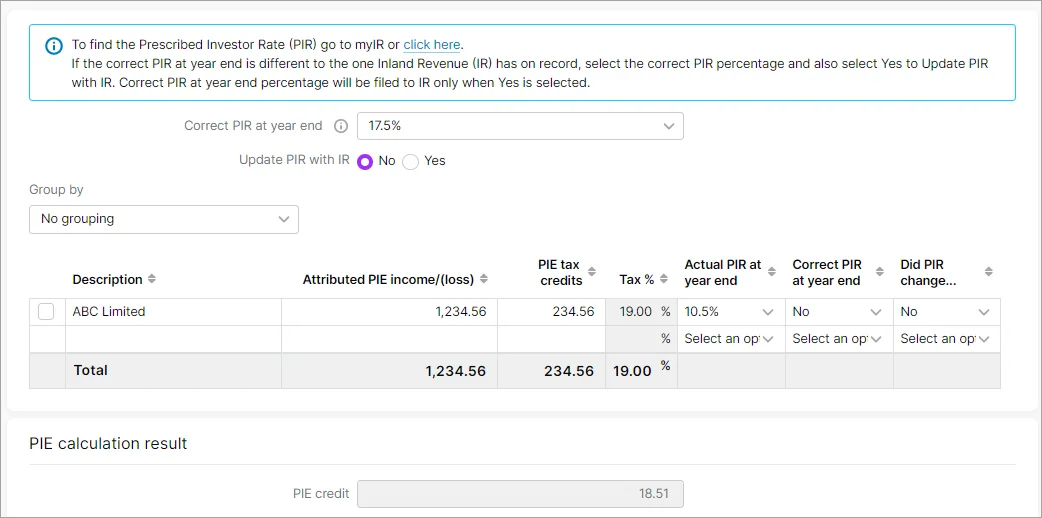
To find your client's PIR, you can look in myIR or use the IR’s find my prescribed investor rate tool.
On the Portfolio investment entity (PIE) income page, click the Correct PIR at year end drop-down and select the relevant option.
2023 returns onward: If you want to file the Correct PIR at year end percentage to IR, select Yes at Update PIR with IR. You only need to do this if the rate is different to what IR currently has on record.
In the table, select the relevant option in these three fields:
Actual PIR at year end
Correct PIR at year end
Did PIR change during the year?

The calculation will appear in PIE calculation result:
If the result is a PIE debit, it'll be added to the tax to pay.
If the result is a PIE credit, it'll be deducted from any tax to pay.


To learn more, check out IR's PIE help page and Information for resident individuals who invest in PIE.
Add the PIE schedule for other return types before 2026
Follow these steps to add a schedule for:
a 2020 IR3, or
tax years before 2026 for an IR3NR, IR4, IR6 or IR7.
In the Tax return page, click the Attachments and schedules to expand it.
Open the Portfolio investment entities (PIE) income schedule.
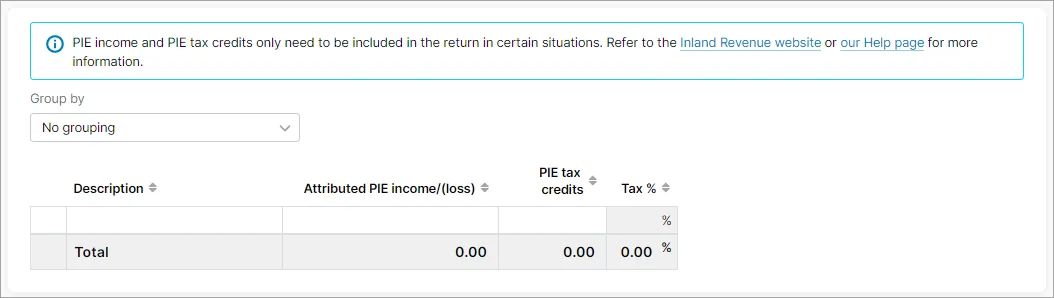
In the table, enter the relevant information into the fields. You can only enter a positive PIE tax credit amount for IR3NR, IR4, IR6 and IR7 returns. If you have a negative amount, review whether you need to include the PIE income and tax credits from that source.
