The income allocation workpaper is used to accurately distribute income for beneficiaries and partners.
This workpaper is available for Trust and Partnership entities in workpaper and the Financial Statement workflow.
Map beneficiary accounts
Before using the Income allocation workpaper, make sure your client’s beneficiary accounts are mapped correctly.
Go to the Account mapping page, where you’ll find 20 stakeholder accounts available to map to. These are labelled stakeholder accounts, so they are relevant across all entity types.
Whether your client’s data has a single account for each beneficiary, or multiple accounts for things like opening balance, income distribution or loan accounts for each beneficiary, assign each beneficiary to a unique stakeholder account and map all related accounts there.
One stakeholder account per beneficiary is key to ensuring the correct accounts populate the Income allocation workpaper.
Prepare the workpaper
Open the Income allocation workpaper. Each stakeholder account that's been mapped to will have a row.
Enter each beneficiary's legal name in the Stakeholder # field they’ve been assigned to.
Click the hash symbol (#) to view all accounts mapped to that stakeholder account.
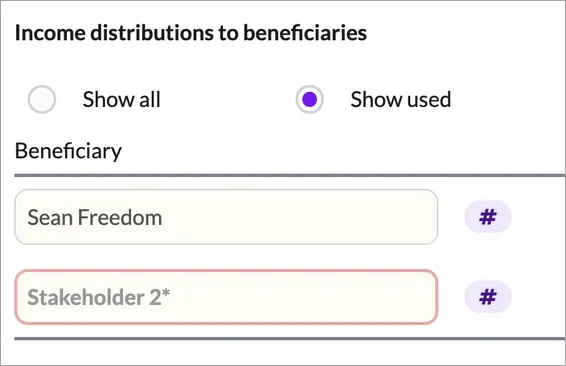
Select the distribution account and click Save. Select only one account for each beneficiary to ensure that the journal populates correctly. Repeat for each beneficiary.
When you’re ready to distribute income, the workpaper offers three flexible methods. The default is to distribute a percentage of net profit or loss, which you’ll see set at the top of the workpaper. The three options are:
Fixed amount allocation: For this option, enter the fixed amount next to each beneficiary in the Fixed amount field.
Percentage of net profit allocation: For this option, enter the percentage for each beneficiary in the Percentage of net profit field.
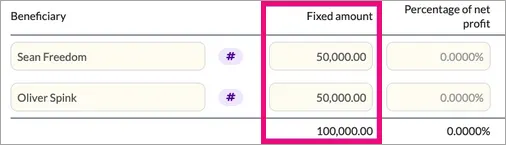
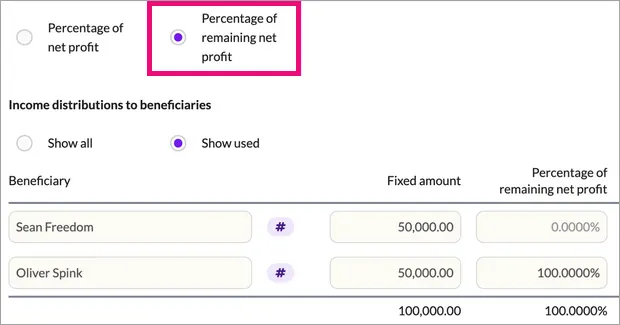
A combination of fixed amount and percentage:
For this option, select the Percentage of Remaining Net Profit option at the top of the workpaper.
Enter the fixed amount in the Fixed amount field next to the relevant beneficiary.
Enter the percentage in the Percentage of remaining net profit field next to the relevant beneficiary.
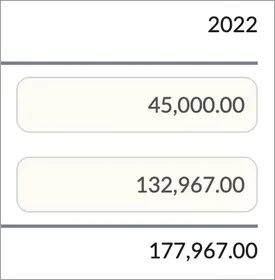
You’ll also see a column for the comparative year amounts. In the first year of preparation, enter the amounts if you want to show comparative amounts in the income statement. Comparative amounts will automatically flow through in subsequent years.


The workpaper automatically calculates the percentage amounts in the Amount column and the total distribution, including fixed amounts, in the Total Distribution column.
At the bottom of the workpaper, the Distribution summary table displays percentages and amounts to help with tax return preparation.
Roll forward from previous year
The following data will rollover if there is an income allocation workpaper in the previous period.
Key points
-
Make sure you roll over workpapers that has compartives. If you roll over a blank workpaper, then the compartives are ‘locked’ and you’ll need to reset them manually (See instructions at If you edit the prior year data after rolling over)
-
For the first comparative year, roll forward the trial balance and roll‑forward balances, then enter any comparative workpaper amounts in the current period. From the following year, the comparative amounts will come through when you roll forward the workpaper.
Comparative column auto‑fills
The comparative (prior year) column in the new year is automatically sourced from the prior year’s Total distribution column on the Income allocation workpaper.
The comparative amounts show as a read‑only last‑year column, and the current‑year fields stay editable.
Stakeholder information
Stakeholder names in the Entity Information will rollover into the Income allocation rows each year.
Linked stakeholder/partner accounts and any notes/attachments on the workpaper roll forward, so you don’t have to rebuild the structure every year.
Comparative distribution amounts when using Client Accounting in the first year
If you use Client Accounting in the first year, you’ll need to manually enter the comparative distribution amounts in the comparative column. From the following year, these amounts will roll over.
Posting an adjustment journal
You can post the adjustment journal for this distribution if it isn’t already posted.
Click Post adjustment, review the pre-populated accounts and amounts and click Add.